Preventing and De-Escalating Complaints in Plastic Surgery Nursing
Plastic surgery nursing is one of the most rewarding specialties in healthcare, yet also one of the most emotionally demanding. Patients arrive with high hopes, strong emotions, and deeply personal motivations for change. When results meet expectations, the journey is fulfilling for both patient and team. When things go wrong, even slightly, the emotional fallout can be intense.
Complaints are an inevitable part of surgical practice, but they don’t have to lead to conflict or reputational harm. Skilled nurses can transform complaints into moments of understanding and reassurance — preserving patient trust and protecting the clinic.
This comprehensive guide explores why patients complain, how to prevent issues through clear communication and realistic expectations, and how to de-escalate complaints when they arise. It also includes practical advice on documentation, legal awareness, emotional wellbeing, and continuous improvement.
Why Patients Complain: Unmet Needs vs. Unmet Expectations
Most patient complaints fall into two categories: unmet needs and unmet expectations.
Unmet needs are tangible — safety, pain relief, cleanliness, and timely care. These are fundamental responsibilities of clinical practice.
Unmet expectations, however, are emotional and subjective — what patients hoped to experience or achieve. They might have expected to feel instantly confident, to look “perfect,” or to recover without bruising. When these expectations aren’t aligned with reality, disappointment turns to frustration or blame.
Plastic surgery patients are especially vulnerable because their procedures are so intertwined with self-image. Many come from long emotional journeys — post-weight-loss transformations, recovery from pregnancy, illness, or trauma. Understanding this emotional background is crucial for managing expectations and preventing dissatisfaction.
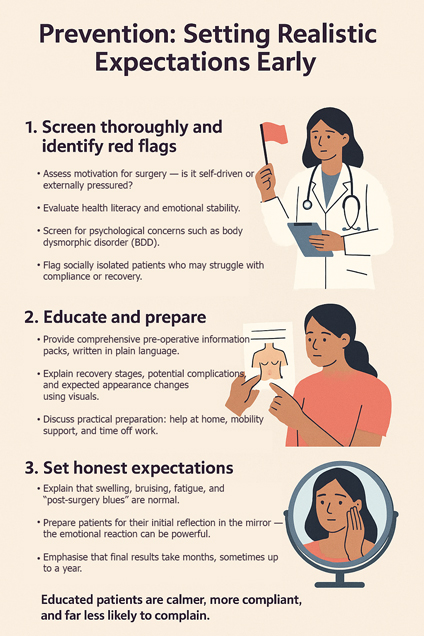
Prevention: Setting Realistic Expectations Early
Preventing complaints begins long before the patient walks into theatre.
1. Screen thoroughly and identify red flags
Assess motivation for surgery — is it self-driven or externally pressured?
Evaluate health literacy and emotional stability.
Screen for psychological concerns such as body dysmorphic disorder (BDD).
Flag socially isolated patients who may struggle with compliance or recovery.
2. Educate and prepare
Provide comprehensive pre-operative information packs, written in plain language.
Explain recovery stages, potential complications, and expected appearance changes using visuals.
Discuss practical preparation: help at home, mobility support, and time off work.
3. Set honest expectations
Explain that swelling, bruising, fatigue, and “post-surgery blues” are normal.
Prepare patients for their initial reflection in the mirror — the emotional reaction can be powerful.
Emphasise that final results take months, sometimes up to a year.
Educated patients are calmer, more compliant, and far less likely to complain.
Communication Strategies That Prevent Patient Complaints
Plastic surgery is communication-intensive. The tone, consistency, and authenticity of every interaction matter.
Build trust early A genuine smile, warm greeting, and attentive presence set the tone. Take time to know each patient’s story — not just their medical history but their motivation and lifestyle.
Keep communication consistent Conflicting messages between admin, nursing, and the surgeon erode confidence. Establish shared scripts or key phrases to keep communication aligned.
Personalise your approach Read the room. Some patients need gentle reassurance; others respond better to structure and clarity. Adjust tone and pace accordingly.
Be transparent If complications or near-misses occur, tell patients promptly. Transparency prevents speculation and maintains trust.
Document everything Write accurate, objective notes on education provided, follow-up calls, and patient responses. Good documentation supports continuity of care and protects against legal or disciplinary challenges.
Framework for De-Escalating Patient Complaints
When complaints arise, nurses are often the first to respond. Having a calm, structured approach helps ensure issues are resolved with empathy and professionalism.
Step 1: Listen fully Let the patient speak without interruption. Maintain open posture and eye contact. Many complaints de-escalate simply because the patient feels heard.
Step 2: Stay calm and kind Avoid defensive or dismissive responses. Recognise that complaints often stem from fear or overwhelm rather than hostility.
Step 3: Acknowledge and clarify Validate emotions (“I can see this has been upsetting for you”). Then clarify facts gently and provide clear, accurate information.
Step 4: Maintain boundaries If a patient becomes verbally aggressive, calmly state that the conversation will continue when it can remain respectful.
Step 5: Provide solutions and follow-up Offer concrete next steps — a review appointment, wound assessment, or call from the surgeon. Follow up to confirm resolution.
Step 6: Document and communicate Record the details and share with the wider team so everyone remains consistent in messaging and aware of context.
Best Phrases, Questions, and Actions to Handle Patient Complaints
1. First Response – Listening and Calming the Situation
Purpose: Lower the patient’s emotional intensity and show immediate empathy.
Best Phrases:
“I can see this has been upsetting for you — let’s take a moment to go through what’s happened.”
“Thank you for telling me. I really want to understand what’s worrying you.”
“I can imagine that must feel frustrating / painful / disappointing.”
“I’d like to make sure I have all the details so we can help you properly.”
“Let’s go through this together so we can find the best way forward.”
Good Questions:
“When did you first notice the issue?”
“Can you describe what you were expecting to happen?”
“What outcome would you feel comfortable with?”
“Is this something you’ve spoken to anyone else about yet?”
“What’s been the hardest part of this experience for you so far?”
Things to Do:
Move to a quiet, private space where the patient can speak freely.
Sit down (standing over a patient heightens tension).
Maintain open, calm body language and natural eye contact.
Let the patient speak without interruption.
Take notes and confirm details back to ensure accuracy.
2. Showing Empathy Without Taking Blame
Purpose: Validate emotions while staying professional and neutral.
Best Phrases:
“I can see how that would be upsetting.”
“I understand this hasn’t gone the way you expected.”
“It sounds like you’ve had a difficult few days — thank you for sharing that.”
“We’ll do everything we can to get this sorted for you.”
“I really appreciate you letting us know — this helps us help you better.”
Things to Avoid:
Avoid phrases like “There’s nothing wrong” or “That’s normal.” They shut down the conversation.
Avoid over-apologising (“I’m so sorry, this is terrible”) — it can sound like an admission of fault.
Avoid medical jargon or defensive explanations too early.
Better Alternatives:
“Let’s take a look and see what’s going on.”
“This sometimes happens, and we have a clear plan for how to manage it.”
“I’ll make sure the surgeon is aware of your concern.”
3. Reassuring and Reframing the Concern
Purpose: Calm anxiety by reframing the situation with clear information and reassurance.
Best Phrases:
“You’re not alone — many patients experience this during healing.”
“The good news is that this is something we can usually manage easily.”
“What you’re seeing is part of the normal recovery phase, but let’s make sure everything’s healing as it should.”
“It might look worrying now, but it will continue to improve with time.”
“Our priority is making sure you feel supported through this.”
Reassuring Questions:
“Would it help if we explained exactly what’s happening under the skin?”
“Would you like me to show you some photos of how this stage normally looks?”
“Can I arrange a quick review with the surgeon to give you extra peace of mind?”
Things to Do:
Provide written aftercare instructions again to reinforce clarity.
Demonstrate wound care or dressing changes step-by-step.
Use visual aids or diagrams when explaining healing or complications.
Offer realistic timelines for improvement rather than vague reassurances.
4. Redirecting an Emotional Conversation
Purpose: Keep the discussion constructive when emotions escalate.
Best Phrases:
“I really want to help you, and I can do that best if we focus on what’s most important to you right now.”
“I can hear that this has been very upsetting. Let’s talk about what we can do from here.”
“I’d like to make sure I fully understand before we make a plan — can you tell me what you were hoping for?”
“It sounds like you’ve been under a lot of stress. Let’s take a breath and work through this step by step.”
Boundary Phrases (for aggressive or abusive behaviour):
“I understand you’re upset, but I need us to keep this conversation respectful so I can help you.”
“If you’d prefer to take a short break, I can call you back later when things have settled.”
“I want to listen and resolve this, but I can’t do that while being spoken to like that.”
Things to Do:
Keep voice tone steady and quiet — this naturally lowers patient tone.
If needed, pause or step out for a short time to de-escalate.
Always have another team member nearby for support if safety is a concern.
5. Problem-Solving and Offering Solutions
Purpose: Move from emotion to action by showing the clinic has a plan.
Best Phrases:
“Here’s what we can do right now to help.”
“We can arrange for the surgeon to review you this week.”
“Let’s recheck your wound and make sure healing is on track.”
“I’ll make a note for our team so we can follow up in 48 hours.”
“Our goal is to make sure you’re comfortable and confident with your recovery.”
Questions to Guide Resolution:
“What outcome would make you feel more reassured?”
“Would you prefer to come in for a quick check or have me send photos to the surgeon today?”
“Is there anything else worrying you that we haven’t covered?”
Things to Do:
Offer specific, time-bound actions — patients feel calmer when they know what’s next.
Document everything clearly, including agreed actions.
Follow up promptly at the promised time, even if only to say “I’m checking in.”
6. When to Escalate to the Surgeon or Manager
Purpose: Recognise when an issue exceeds nursing scope or requires higher intervention.
When to Escalate:
The patient insists on speaking with the surgeon.
There is potential clinical risk (infection, breakdown, unexpected pain).
The patient threatens legal or regulatory action.
The complaint involves money, refunds, or consent issues.
Best Phrases to Use When Escalating:
“I think it would be helpful for the surgeon to review this with you directly.”
“I’ll make sure Dr [Name] is aware of your concern and gets back to you as soon as possible.”
“Let me bring in our practice manager so we can make sure this is handled properly.”
Things to Do:
Provide a short written summary of what the patient reported.
Notify your team immediately so messaging stays consistent.
Ensure no promises or admissions are made before escalation.
7. Follow-Up After Resolution
Purpose: Rebuild trust and show ongoing care.
Best Phrases:
“I just wanted to check how things are going since we last spoke.”
“I’m glad we were able to sort that out — how are you feeling now?”
“Is there anything else I can do to make your recovery more comfortable?”
“Please don’t hesitate to contact us if anything changes — we’d rather you call early than worry.”
Things to Do:
Follow up within 24–48 hours of resolution.
Record the outcome, patient response, and any ongoing plan.
Share lessons with the team if it reveals a communication gap or process issue.
8. Positive Language Substitutions
Replace reactive or defensive wording with professional, patient-centred alternatives.
Instead of Saying
Try This
“That’s not our fault.”
“Let’s look at what’s happened so we can help you.”
“You must have done something wrong.”
“Let’s go over your post-op care together and see what might have affected healing.”
“There’s nothing we can do.”
“Here’s what we can do to make this better.”
“That’s just how it is.”
“It’s common for healing to look like this, but let’s keep monitoring it.”
“You’ll be fine.”
“This can take time, but you’re on the right track. Let’s stay in touch.”
“We’ve never had that happen before.”
“I can see why you’d be concerned — let’s address this carefully.”
“It’s not my department.”
“Let me connect you with the right person who can help.”
9. Best Things to Do During a Patient Complaint
Stay calm, polite, and professional no matter the tone of the patient.
Take ownership of the interaction — avoid handballing too early.
Reflect back the concern to confirm understanding.
Offer small but visible actions quickly (a call, review, or information sheet).
Keep your voice low and measured — this encourages patients to match your tone.
Write a factual summary immediately after the interaction.
Debrief with your team or mentor for emotional and practical support.
10. Final Empathy Phrases That Rebuild Patient Trust
When the situation is resolving, finish with phrases that reinforce partnership and care:
“We’re really glad you came in and talked to us — it helps us make sure you’re looked after properly.”
“You’ve done exactly the right thing by letting us know early.”
“We’ll stay in touch over the next few days to make sure everything keeps improving.”
“We appreciate your patience — we know this hasn’t been easy.”
“Thank you for giving us the chance to make things right.”
Case Examples: Turning Complaints into Positive Outcomes
1. Distress over scar appearance A patient was alarmed by the size of her post-operative scar. The nurse listened empathetically and explained why surgeons remove wider margins to ensure full cancer clearance and optimal wound tension. The patient left reassured and later expressed gratitude for the clear explanation.
2. Severe pain one week after surgery A patient called distressed by pain and swelling. The nurse triaged promptly and arranged an immediate review. The surgeon saw the patient the same morning, resolving the issue and reinforcing trust.
3. Emotional shock after garment removal A patient burst into tears after seeing her body for the first time post-abdominoplasty. The nurse held space, normalised the reaction, and stayed with her until she felt calm. That empathetic presence prevented escalation and strengthened rapport.
The Emotional Impact on Nurses and Team Members
Handling patient complaints can take a heavy emotional toll. Nurses are compassionate by nature and often internalise patient distress. When confronted with criticism, it’s easy to feel personally attacked or demoralised.
Recognising these feelings is essential. After difficult interactions:
Debrief with a colleague or manager — talking it through helps diffuse stress.
Avoid replaying the event mentally; focus on what you learned.
Keep perspective: most complaints are about circumstances, not about you.
Maintain self-care routines — rest, exercise, and downtime are protective.
Creating a clinic culture that normalises open debriefing and emotional support prevents burnout and strengthens team resilience.
Legal and Risk Management Considerations
Every complaint carries potential legal and reputational implications. Nurses play a crucial role in risk mitigation.
Document thoroughly
Write factual, objective notes in the Practice Software (EHR) after every significant interaction.
Avoid subjective language or speculation.
Record time, date, and participants for clarity.
Maintain confidentiality
Never discuss cases outside appropriate professional settings.
Follow privacy laws and clinic policy when handling photos or records.
Escalate appropriately
Alert the surgeon or practice manager early if a complaint suggests clinical error, risk of harm, or reputational exposure.
Never promise compensation or admit fault without guidance.
Follow open disclosure principles
If an unexpected event occurs, provide honest, compassionate communication outlining what happened, how it will be managed, and next steps.
Legal safety begins with consistent, clear documentation and a culture of transparency.
Handling Written or Online Complaints
Complaints increasingly arrive by email or social media rather than face-to-face. Handling them well requires professionalism and restraint.
1. Respond promptly and privately Acknowledge receipt quickly, even if the full response will follow later. Invite the patient to discuss the issue by phone or in person.
2. Never argue online Avoid replying to negative reviews or posts beyond a neutral statement such as: “We’re sorry to hear you’re unhappy and would like to discuss this directly. Please contact the clinic.”
3. Keep written communication factual and calm Written tone can easily be misinterpreted. Keep responses short, polite, and professional.
4. Record all correspondence Save copies of emails and messages in the patient’s record.
5. Notify management Escalate online or written complaints to the practice manager or risk advisor early.
Post-Complaint Reflection and Quality Improvement
Every complaint is a learning opportunity. Once resolved, review what happened objectively.
What triggered the concern — communication, timing, recovery, or system gaps?
Could improved education or documentation have prevented it?
Are there patterns emerging across multiple patients?
How can systems be refined to reduce recurrence?
Share lessons with the wider team. Celebrate when improvements lead to better experiences. Turning feedback into progress builds a culture of excellence and trust.
Training and Continuing Education for Nurses
Ongoing education ensures nurses stay confident and capable in communication and complaint handling.
Recommended focus areas:
Emotional intelligence and empathy training — recognising and managing emotions during difficult conversations.
Communication workshops — practising de-escalation language and body cues.
Risk documentation refreshers — accurate note-keeping and open disclosure.
Scenario-based roleplay — rehearsing responses to common complaint situations.
Encourage team members to complete relevant CPD modules annually and incorporate communication training into staff orientation programs.
Clinic Culture and Systems to Support Patient Complaint Management
A supportive clinic culture and clear operational systems underpin complaint prevention.
Team alignment – surgeons, nurses, and admin must communicate consistently.
Continuity of care – patients should have one point of contact throughout their journey.
Proactive follow-up – scheduled calls or check-ins after surgery reassure patients and detect early concerns.
Robust documentation – precise records and privacy safeguards protect both patients and staff.
Emotional support systems – regular debriefing and recognition of staff wellbeing sustain morale.
Do’s and Don’ts for Handling Patient Complaints
7 Do’s to Prevent and De-escalate Complaints
Do listen fully before responding – let patients share their concerns without interruption.
Do set realistic expectations early – be upfront about scars, swelling, timelines, and emotional ups and downs.
Do keep communication consistent – ensure admin, nurses, and surgeons deliver the same messages.
Do use empathy and calm body language – your tone and presence can diffuse heightened emotions.
Do document every interaction – record concerns, advice given, and follow-up for continuity and protection.
Do provide proactive follow-up – a check-in call or message often prevents a small worry from becoming a complaint.
Do escalate to the surgeon when needed – involve the surgeon promptly if reassurance alone isn’t enough.
7 Don’ts to Prevent and De-escalate Complaints
Don’t dismiss or minimise patient feelings – even if the concern seems minor, validation matters.
Don’t give mixed or contradictory information – inconsistency erodes trust and fuels dissatisfaction.
Don’t become defensive or argumentative – this escalates tension and undermines professionalism.
Don’t ignore early red flags – address unrealistic expectations or repeated worries before surgery.
Don’t allow abusive behaviour – set respectful boundaries and pause the interaction if needed.
Don’t forget to follow up – unresolved concerns left hanging nearly always resurface as complaints.
Don’t take it personally – most complaints are about unmet expectations, not about you as a nurse.
FAQs for Patient Complaints
General Complaint Handling FAQs
Q: How should I respond when a patient begins to complain at the front desk in front of others?
Stay calm, acknowledge them softly, and invite them to a private space. Say, “Let’s step into a quieter room so I can give you my full attention.” This lowers tension, protects privacy, and prevents embarrassment for both the patient and others in the waiting area.
Q: What should I do if I don’t know the answer to a patient’s question during a complaint?
Never guess. Acknowledge honestly: “That’s an important question — I want to confirm the details before I answer.” Then follow up quickly with the correct information. Patients value honesty more than instant answers.
Q: How do I handle a patient who complains about waiting times?
Acknowledge frustration without making excuses. “I understand your time is valuable, and I’m sorry you’ve had to wait. The doctor is finishing with another patient, and we’ll get to you as soon as possible.” Offer updates and keep communication open.
Emotional and Difficult Behaviour FAQs
Q: What’s the best way to calm an angry or shouting patient?
Lower your voice, slow your pace, and keep your body language relaxed. Don’t mirror their tone. A steady response like, “I can hear you’re upset — let’s talk about what’s happened,” often helps them settle.
Q: How do I stay professional when a complaint feels personal or unfair?
Remind yourself the anger is directed at the situation, not you. Focus on the facts. Keep your voice neutral and your posture open. Debrief later with a trusted colleague to offload emotion constructively.
Q: What if a patient starts crying while complaining?
Pause, give them space, and show empathy. Offer tissues and say, “It’s okay — take your time.” Let them regain composure before continuing. Sometimes silence and presence are the most powerful tools you have.
Communication and Language FAQs
Q: How can I make my language more reassuring without making promises?
Use collaborative phrases such as “We’ll work through this together” or “You’re in good hands.” Avoid guarantees like “Everything will be fine.” Instead, focus on your commitment to support and problem-solve with them.
Q: What’s the best way to explain normal healing that looks abnormal to a patient?
Validate their worry first: “I can understand why that looks concerning.” Then reframe with facts. “At this stage, swelling and bruising are common and part of the normal healing process. Let’s review how it’s progressing.”
Q: What if English isn’t the patient’s first language and they seem confused?
Use short sentences, plain words, and gestures. Supplement explanations with diagrams or translated information sheets. Check understanding by asking them to repeat key points back in their own words.
Documentation and Legal Protection FAQs
Q: What exactly should I document after managing a complaint?
Record the date, time, patient concern, your response, education provided, and follow-up plans. Keep notes factual and objective — never include personal feelings or assumptions. Documentation is your strongest professional safeguard.
Q: What if a patient refuses to let me document their complaint?
Explain that accurate record-keeping protects both the patient and the clinic. “Documentation helps ensure we’re clear on what was discussed and how we’re supporting you.” Transparency usually eases concern.
Q: How long should complaint-related notes be kept?
Follow your clinic’s data retention policy and national regulations. Generally, complaint notes should be stored as part of the medical record for at least seven to ten years, or longer for minors.
Clinical and Surgical Journey FAQs
Q: What if a patient complains that their results look uneven soon after surgery?
Explain that early asymmetry often results from swelling, bruising, or muscle tension. Reassure them: “It’s too early to judge results — let’s reassess once healing is more advanced.” Always offer a follow-up review.
Q: How should I respond when a patient blames the nurse or surgeon for a normal complication?
Acknowledge distress, then explain calmly: “I can see this has been upsetting. Some complications can occur even when everything is done correctly. Let’s focus on managing it together so you heal well.”
Q: What if a patient develops a real complication and threatens to post on social media?
Avoid confrontation. Respond with empathy: “I understand you’re upset and want to share your experience. Can we talk first to make things right for you?” Escalate to the surgeon or practice manager immediately.
Online, Written, and Third-Party Complaint FAQs
Q: How should we handle an angry email or message?
Acknowledge receipt promptly and privately. “Thank you for reaching out — I’m sorry to hear you’re unhappy. I’d like to discuss this personally so we can help.” Move the conversation offline for tone control.
Q: What should I do if a patient leaves a negative Google review?
Never argue online. Post a neutral, professional response such as, “We’re sorry to hear you were disappointed. Please contact us directly so we can resolve this privately.” Always notify management.
Q: Can I apologise without admitting fault?
Yes. Say, “I’m sorry that this experience has been distressing for you.” Expressing empathy doesn’t admit liability; it acknowledges emotion and maintains professionalism.
Teamwork and Escalation FAQs
Q: When should I escalate a complaint to the surgeon or practice manager?
Escalate immediately if there’s a threat of legal action, reputational damage, refund demand, or patient safety risk. Also escalate if the patient remains dissatisfied despite your best de-escalation efforts.
Q: How can I best support the surgeon after a serious complaint?
Be consistent in communication with patients, protect confidentiality, and show empathy for the surgeon. A quiet check-in such as “Are you okay after that situation?” reinforces teamwork and trust.
Q: How should the nursing team debrief after a difficult complaint?
Hold a short, open discussion with no blame. Identify what worked, what didn’t, and agree on process improvements. Debriefing normalises learning and reduces emotional fatigue.
Self-Care and Professional Resilience FAQs
Q: How do I avoid burnout when dealing with emotional or angry patients often?
Set boundaries, debrief regularly, and practise emotional detachment — care deeply but don’t absorb the distress. Make time for physical exercise, rest, and supportive conversations outside of work.
Q: How can I stay confident after being the subject of a complaint?
Seek feedback from your supervisor to gain perspective. Remember that one complaint does not define your skill or compassion. Reflect, learn, and keep showing professionalism — confidence rebuilds through consistent care.
Q: How can I support new nurses who are nervous about handling complaints?
Model calm communication and invite them to observe or assist during complaint discussions. Debrief afterward, share reassuring stories, and highlight that confidence grows with experience and mentorship.
Medical References about Handling Patient Complaints
To build a culture that prevents and manages complaints effectively, plastic surgery nurses and leaders can take the following actions:
Review and refresh your patient education materials — ensure clarity, visuals, and realistic timelines.
Audit your documentation to confirm accuracy, objectivity, and compliance.
Establish clear complaint pathways and escalation processes within the clinic.
Provide emotional support and structured debriefs after difficult patient interactions.
Schedule communication and empathy training for the entire team.
Track and review complaints quarterly to identify trends and implement improvements.
Complaints in plastic surgery nursing are inevitable, but they don’t have to damage patient relationships or a clinic’s reputation. By setting realistic expectations, communicating consistently and empathetically, and following a structured approach to de-escalation, nurses can transform complaints into positive outcomes.
Every difficult conversation is a chance to show patients that they are heard, valued, and supported. Done well, this not only resolves the issue at hand but builds stronger loyalty, trust, and respect — for the nurse, the surgeon, and the entire practice.
Executive Summary – Key Takeaways
Plastic surgery nursing requires a high level of empathy, professionalism, and communication skill. Complaints often stem not from poor care but from unmet expectations or misunderstandings.
Most complaints are preventable through education, preparation, and clear communication.
Early listening, validation, and transparency can resolve most issues before they escalate.
Consistency across the team, meticulous documentation, and respectful boundaries protect both patients and staff.
Every complaint presents an opportunity to improve systems and strengthen patient relationships.
Final Thought
Preventing and de-escalating complaints in plastic surgery nursing isn’t just about protecting reputation — it’s about human connection. Every interaction is a chance to reassure, educate, and empower patients. When nurses communicate with empathy, consistency, and confidence, they turn challenges into moments that reaffirm why compassionate care is at the heart of great plastic surgery practice.
Specialist Practice Excellence provides Mentoring and Training on Practice Operations, Patient Lead
Generation & Enquiry Conversion for Specialist Surgeon practices in Australia, UK and USA.
Meet the Team
David Staughton
David Staughton is a Melbourne-based business growth strategist, keynote speaker, and certified consultant with 30+ years of experience across multiple industries. He helps specialist surgeons and small businesses improve operations, increase revenue, and build strong teams. David has delivered 750+ talks worldwide and holds CSP and CCEO credentials.
Michelle
Michelle Staughton is a highly experienced Practice Consultant and Operations Coach who specialises in helping specialist medical and surgical practices run more smoothly and efficiently. With extensive experience in healthcare management, she focuses on improving patient experience, streamlining clinic operations, and supporting practice growth.
Brooklyn
Brooklyn has over 8 years of experience in specialty consulting, focusing on business improvement and customer experience. She has worked in Reception, Enquiries, Consulting, and Accounts, giving her a strong understanding of the customer journey. As a mentor, she designs training programs that help teams deliver excellent service with confidence.
What We Do
SPE helps Specialist Surgeons to:
Improve practice operations
Manage time effectively
Grow income sustainably
Build stronger teams and better patient experiences